

TECHNICAL SUPPORT


Published 2026-01-22
The stuttering vibration is usually the first sign of trouble. One minute your machine is gliding with the grace of a professional skater, and the next, it’s twitching. That rhythmic jerk—the "cogging" effect—is the ghost in the machine that ruins precision. When you’re pushing for sub-micron accuracy, a tiny hiccup feels like an earthquake. This is where most motion systems hit a wall. You need speed, but you also need that eerie, silent smoothness that only a perfectly tuned linearservomotor can provide.
Mechanical systems used to be simple. You had a motor, a belt, or a screw, and you accepted the backlash. But the world moved on. Belts stretch like old rubber bands. Lead screws wear down until they have more "play" than a playground. When your project demands a straight-line sprint with a sudden, dead-stop anchor, traditional hardware fails.
The heat starts building up in the coils. Friction bites into the rails. Suddenly, your high-speed sorter or your delicate laboratory slider is dragging its feet. You aren't just losing time; you're losing the very integrity of the movement. This isn't just a hardware issue; it's a service and integration gap.
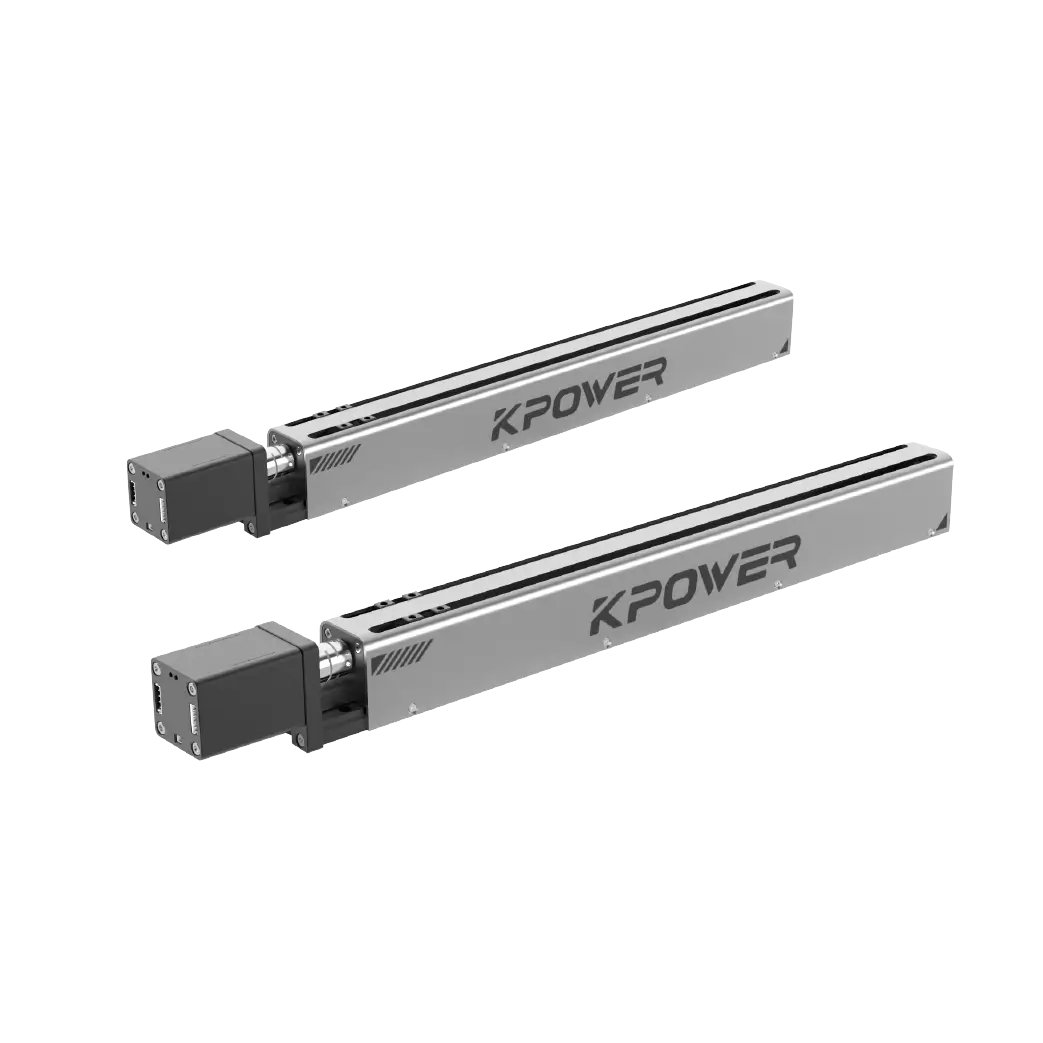
If you want a machine to move like it’s floating on air, you stop fighting physics and start working with it.kpowerdoesn't just look at a linearservoas a hunk of magnets and copper. We treat it as a living pulse. The "service" part of a linearservomotor isn't just about shipping a box; it's about the "tuning" phase—the dark art of matching the drive to the load.
Think about a high-end sports car. You wouldn't put cheap tires on it and wonder why it slides off the track. Akpowerlinear servo is built for that "direct drive" feel. No gears, no belts, just pure electromagnetic force translated into linear travel. It's the difference between pushing a cart with a long, flexible pole and pushing it with your own hands. The response is instantaneous.
Why bother switching? Why deal with the magnets and the sensors?
I remember watching a precision assembly line where they swapped out old actuators for Kpower linear units. The noise floor in the room dropped instantly. You could actually hear the air conditioning for once because the machines stopped screaming.
Q: Does heat ruin the precision? A: It can. If you run a motor poorly, the magnets get grumpy. But a well-designed Kpower system uses the aluminum base as a giant heat sink. We focus on thermal management so the motor stays cool even when it’s cycling a thousand times an hour.
Q: Is it hard to set up? A: It's different, not necessarily harder. You’re dealing with magnetic tracks instead of a simple shaft. It requires a bit of respect for the forces involved. Once the alignment is locked in, it’s basically "set and forget."
Q: Can it handle heavy loads, or is it just for tiny stuff? A: People often think linear servos are "weak." That’s a myth. With the right magnet pitch and current, these things can move heavy slabs of glass or metal with frightening power. It’s all about the force density.
There is a certain peace of mind that comes from knowing the motion profile won't drift. You ever have to recalibrate a machine every Monday morning? That’s usually because a mechanical component expanded, contracted, or wore down. With a Kpower linear setup, the feedback loop is watching the position in real-time. If it’s off by a hair, the system corrects it in microseconds. It’s a self-healing way to move.
Sometimes a project needs a little "soul." You want the movement to feel intentional. When we look at the integration of these motors, we look at the vibrations. We look at the resonance. If the frame of your machine is humming like a tuning fork, the motor service isn't done yet. We help dial out those frequencies so the only thing moving is the part you want to move.
Stepping into the world of linear servos feels like moving from a typewriter to a touchscreen. It’s cleaner. It’s more intuitive. The "service" we provide is about making sure that transition doesn't result in a pile of fried electronics. We focus on the synergy between the magnetic track and the forcer.
If you’ve been struggling with a system that feels sluggish or "mushy," the problem is likely the mechanical lag. Removing the middleman—the gears and belts—is the fastest way to fix it. Kpower provides that direct line of force.
It’s a bit like a dance. The controller sends a whisper, and the forcer glides. No hesitation. No stutter. Just the cold, clean efficiency of electromagnetics doing exactly what they were told to do. It’s not just about getting from point A to point B; it’s about how you feel during the trip. And with Kpower, that trip is as smooth as silk.
Established in 2005, Kpower has been dedicated to a professional compact motion unit manufacturer, headquartered in Dongguan, Guangdong Province, China. Leveraging innovations in modular drive technology, Kpower integrates high-performance motors, precision reducers, and multi-protocol control systems to provide efficient and customized smart drive system solutions. Kpower has delivered professional drive system solutions to over 500 enterprise clients globally with products covering various fields such as Smart Home Systems, Automatic Electronics, Robotics, Precision Agriculture, Drones, and Industrial Automation.
Update Time:2026-01-22

Contact Kpower's product specialist to recommend suitable motor or gearbox for your product.


