

TECHNICAL SUPPORT


Published 2026-01-19
Have you ever encountered this situation - the machine suddenly freezes while it is spinning, or the accuracy quietly drifts away, and you can't get it back no matter how you adjust it? A certain link in the production line slowed down for no apparent reason. After checking for a long time, I found out that a certain small component was "lazy"? This feels like an old car at home, which is always a little awkward to drive.
In fact, many times, the problem lies in those inconspicuous "joints". Servo motors and steering gears are the muscles and joints of the equipment. If they are not powerful, no matter how smart the "brain" is, it will not be able to exert its strength. You may be thinking: I am already using a common model on the market, why is this still happening?
Let's think about it another way. A complex device, like a band. Each musician has to keep up with the rhythm and coordinate with the changes of others at any time. If the trumpeter is half a beat slower, the whole piece will sound weird. The same goes for your equipment—each motor unit needs to respond precisely to commands while also knowing what its “teammates” are doing.
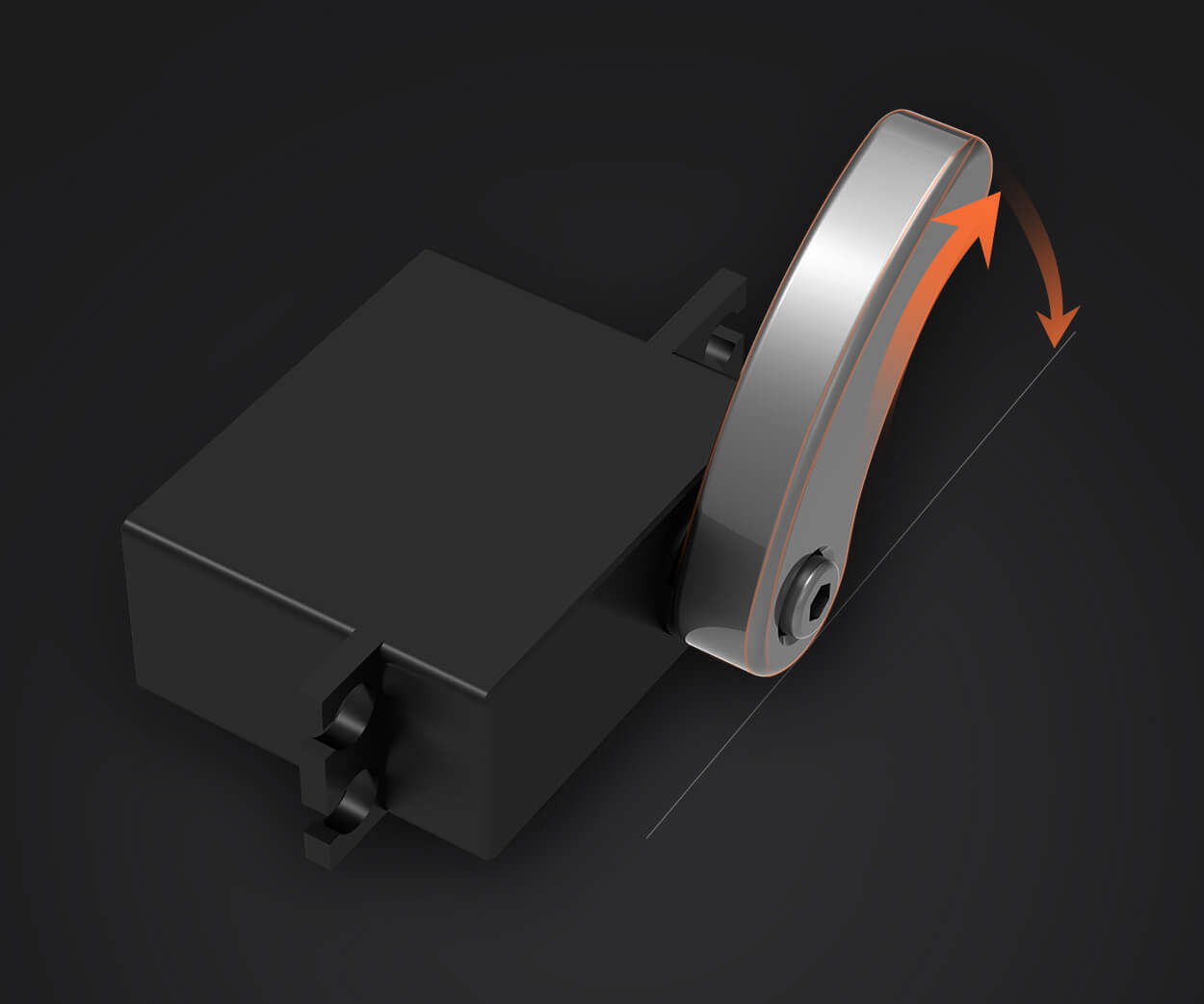
But the reality is that many motor units are "deaf" to each other. They only receive commands but have no idea what is happening in the entire system. This leads to a common dilemma: Parts look normal, but the overall coordination is always poor. Adjust one parameter and a new problem pops up somewhere else. Engineers often have to go back and forth, like solving a chain that will never be solved.
It's like putting invisible headphones on each band member so they can hear each other's breathing and rhythm. In the world of motion control, this "invisible headset" is the ability to exchange data in real time and accurately.
Imagine: when the main motor starts to accelerate, the auxiliary units next to it can "sense" this change in advance and actively adjust their own rhythm to match; when a certain link encounters resistance, other related units can instantly receive an "alert" and make a smooth transition together. This tacit understanding is not cobbled together by complex programming, but comes from their inherent communication methods.
This is where the “microservices io” thinking starts. It is not a simple hardware upgrade, but a redesign of the "dialogue" between motion units. Each unit becomes capable of performing tasks independently while also being acutely aware of the overall environment. They share data as fast as branches of the same nervous system.
It is the improvement of accuracy that becomes natural. The synchronization effect that used to require repeated debugging now seems to happen automatically. Because each unit knows at what time and with what intensity it should act, it is difficult for errors to accumulate.
The response becomes sensitive and soft. Just like a skilled driver shifting gears, you won't feel any sudden frustration. When the device switches between different working modes, the transition is so smooth that it is almost imperceptible. This means less waiting and less waste for production scenarios that require frequent rhythm adjustments.
There’s also a less obvious but important benefit: troubleshooting becomes much more intuitive. Because the status of each unit is transparent, if something goes wrong, you can quickly see which link is "out of tune" instead of worrying about an entire silent machine. This may save more time than you think.
The traditional idea is to make a fuss on the control side - using a more powerful central processor to coordinate everything. It's a bit like having a conductor memorize all the music and then waving his arms like crazy trying to get everyone to keep up. The effect is limited, and the pressure is entirely on the conductor.
Another idea is to equip each unit with an independent "brain" and let them make their own decisions. But this can easily lead to another problem: fragmentation and lack of coordination. "Microservices io" chooses a middle path: let each unit maintain a certain degree of intelligence, but more importantly, establish an efficient communication protocol for them. They are neither completely obedient to the central government nor completely autonomous. Instead, they find their best time to act in the shared information flow.
Behind this iskpowerThe understanding accumulated over many years in the field of mechanical transmission. They found that many performance bottlenecks are not actually insufficient capabilities of individual components, but poor "dialogue quality" between components. Just like a group of people speaking in different dialects, information is constantly lost and distorted during transmission.
Some people describe it this way: after using it, the device seems to suddenly "wake up". The mechanical, step-by-step movements before have become more agile. Especially when dealing with complex curves or variable speed tasks, the smoothness will make people look twice.
Maintenance staff noticed another change: fewer occasions required manual intervention. The system seems to have learned to fine-tune itself. When a certain unit has a slight deviation due to temperature changes, the adjacent units will actively compensate for the deviation, rather than leaving the problem to the final result.
Another practical point: how friendly it is to older devices. You don't need to tear down the entire system and start over. Often you only need to replace the key motion units to feel the improvement in overall performance. It's like replacing the band with several musicians who can listen to each other better, and the performance level of the entire team has been raised to a higher level.
The secret lies in two levels: the signal processing method on the hardware and the decision-making logic on the software layer. The hardware ensures that each unit can send and receive status information with extremely low latency; the software gives them basic "situational judgment" capabilities - not the complex judgments of artificial intelligence, but closer to instinctive reactions: such as "When I feel a sudden increase in load, should I increase the intensity immediately or back off slightly?"
This design greatly enhances the robustness of the system. Even if a certain link is temporarily disrupted, other units can quickly fill the gap and keep the overall operation uninterrupted. For a continuously operating production line, this means more stable output quality.
kpowerWhile developing this product, a lot of time was spent observing various real-life production scenarios. They noticed that many device performance fluctuations actually follow regular patterns - often occurring when switching tasks or responding to sudden resistance. Therefore, it revolves around these critical moments: how to make the motor units behave more calmly and collaboratively at these critical points.
This may be more of a concern than the immediate performance gain. As your device becomes more "coordinated," it becomes more adaptable to different tasks. It may be used to make standardized parts today, and switched to customized small batch production tomorrow, and it can quickly find a stable work rhythm.
What's more, this architecture leaves room for future upgrades. When you want to introduce new processes or higher precision requirements, you don’t need to redesign the entire motion control solution. You often only need to enhance or update some units. This kind of flexibility, in today's era of rapid technology iteration, may be more practical than pure performance parameters.
After all, the evolution of equipment is not just to be faster or stronger, but also to use every bit of energy more intelligently and complete every action more harmoniously. When each movement unit can focus on its own job while also being able to see six directions, the potential of the entire equipment will be truly released. This may be the shift that is quietly taking place in modern mechanical design - from pursuing the ultimate in individual components to pursuing the elegance of overall collaboration.
Is your device ready to start new conversations?
Established in 2005,kpowerhas been dedicated to a professional compact motion unit manufacturer, headquartered in Dongguan, Guangdong Province, China. Leveraging innovations in modular drive technology, Kpower integrates high-performance motors, precision reducers, and multi-protocol control systems to provide efficient and customized smart drive system solutions. Kpower has delivered professional drive system solutions to over 500 enterprise clients globally with products covering various fields such as Smart Home Systems, Automatic Electronics, Robotics, Precision Agriculture, Drones, and Industrial Automation.
Update Time:2026-01-19

Contact Kpower's product specialist to recommend suitable motor or gearbox for your product.


