

TECHNICAL SUPPORT


Published 2026-07-31
SEO Title: How to Choose a BLDC Motor for RC Plane Performance
Meta Description: BLDC motors for RC planes affect thrust, flight time, and reliability. Learn how to match motor size, KV rating, and propeller load to your airframe before you buy.
01How to Choose a BLDC Motor for RC Plane Performance
Quick Answer
A BLDC motor for an RC plane converts battery power into rotational thrust with higher efficiency and lower maintenance than brushed alternatives. The right motor depends on your airframe weight, desired thrust-to-weight ratio, propeller size, and battery voltage. Choosing a motor with the wrong KV rating or power class can cause overheating, poor climb performance, or shortened flight times. Always match motor specifications to your plane's weight and intended flying style before purchasing.
Introduction
Every RC plane builder reaches the same point: the airframe is ready, theservos are installed, and then the motor decision stops the project cold. Pick a motor that is too small, and the plane will struggle to climb. Pick one that is too large, and you carry dead weight that shortens flight time and stresses the airframe. In many cases, the difference between a satisfying build and a frustrating one comes down to a few specification numbers that are easy to misinterpret.
The problem is not a lack of options. The market is full of BLDC motors in every size, KV rating, and price bracket. The real challenge is understanding which specifications matter for your specific plane. A motor that performs beautifully on a 3D aerobatic airframe may be completely wrong for a slow-flying trainer. Without a clear method for matching motor output to airframe requirements, buyers often default to price or brand reputation, which does not guarantee a correct match.
This article walks through the selection process from a procurement and engineering perspective. You will learn how to read motor specifications, how to match them to your airframe, and what to check before you commit to a purchase. The goal is not to recommend a single product, but to give you a repeatable method for evaluating any BLDC motor against your specific requirements.
Table of Contents
Why the Motor Choice Affects Flight Performance and Cost
Understanding BLDC Motor Specifications for RC Aircraft
How to Match Motor Power to Your Airframe Weight
KV Rating and Propeller Selection: What Actually Matters
Battery Voltage and Current Draw: Planning the Power System
What Buyers Should Check Before Choosing a BLDC Motor
Common Mistakes That Lead to Motor Failure or Poor Flight
Key Specifications to Compare Before Ordering
Questions Buyers Often Ask About BLDC Motors for RC Planes
Choosing the Right Motor for Your Application
Why the Motor Choice Affects Flight Performance and Cost
The motor is the single component that determines whether your plane can climb, cruise, or perform aerobatic maneuvers. It also drives the size and cost of the battery, the electronic speed controller, and the propeller. A mismatch anywhere in this chain creates a ripple effect: the motor draws too much current, the battery sags under load, the ESC overheats, and the entire power system becomes unreliable.
For buyers managing multiple builds or a small fleet, the cost impact compounds. A motor that is undersized for the airframe may run hot and fail prematurely, requiring replacement within a season. A motor that is oversized forces you to buy a larger battery and ESC, increasing the total power system cost beyond what the airframe actually needs. Neither outcome is acceptable when the goal is predictable performance and controlled spending.
The professional approach is to work backward from the airframe. Know the all-up weight, decide the thrust-to-weight ratio your flying style requires, and then select a motor that delivers that thrust without exceeding the battery's discharge capability. This method removes guesswork and gives you a defensible basis for comparing motors from different manufacturers.
Understanding BLDC Motor Specifications for RC Aircraft
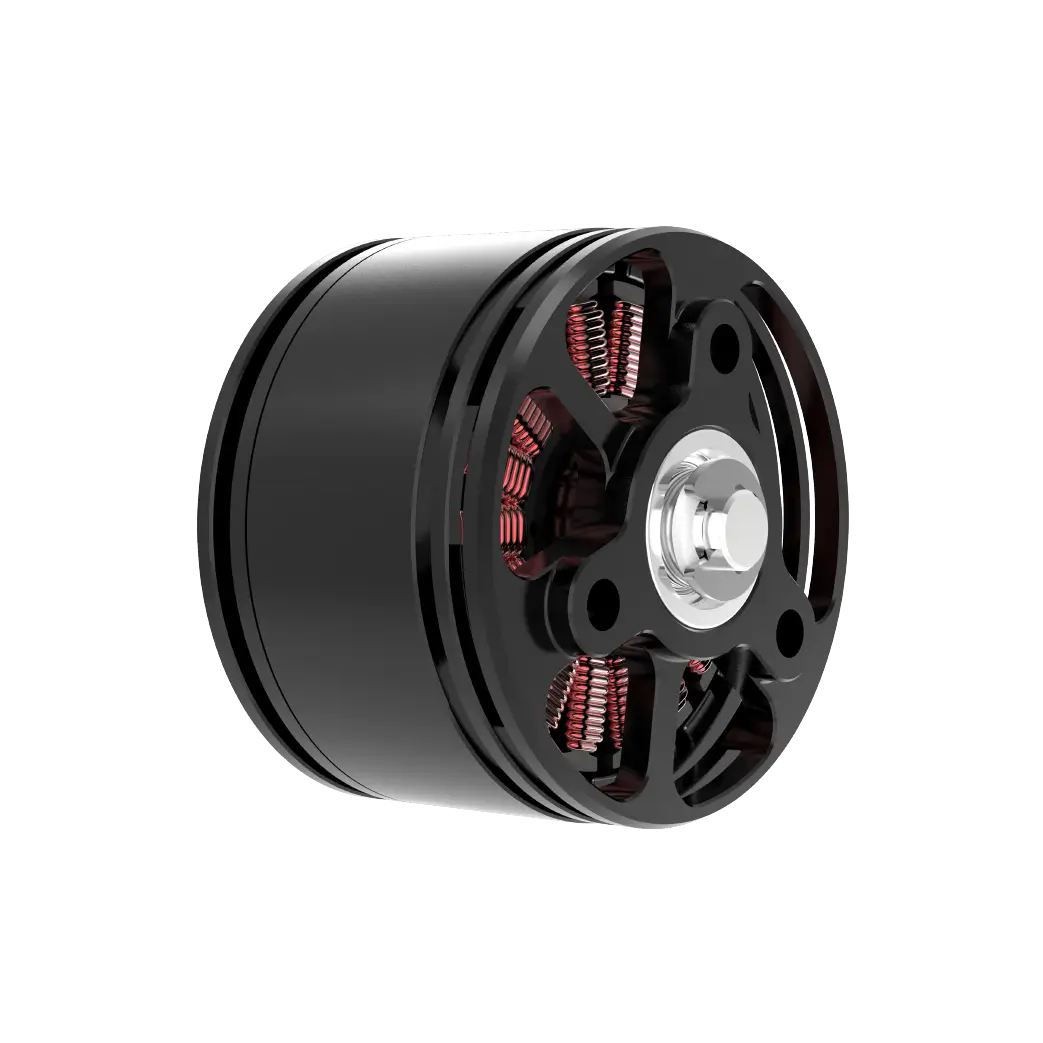
A brushless DC motor for RC planes is defined by several key specifications: stator size, KV rating, maximum current, and power output. The stator size, expressed as a number like 2212 or 3548, indicates the motor's physical dimensions. The first two digits represent the stator diameter in millimeters, and the last two represent the stator length. Larger stators generally handle more power and produce more torque.
The KV rating is the motor's speed constant, measured in RPM per volt. A motor with a KV rating of 1000 will spin at approximately 1000 RPM per volt applied, under no load. This number determines which propeller sizes are appropriate. High-KV motors spin fast and suit small propellers, while low-KV motors spin slower and suit larger propellers. The relationship between KV and propeller size is one of the most misunderstood aspects of motor selection.
Maximum current, expressed in amperes, tells you the sustained current the motor can handle without overheating. This rating assumes adequate airflow and proper throttle management. Exceeding the maximum current for extended periods can demagnetize the rotor or damage the windings. Buyers should verify this rating against the expected current draw of their propeller and battery combination.
How to Match Motor Power to Your Airframe Weight
The most reliable starting point for motor selection is the thrust-to-weight ratio. For a trainer or scale plane, a ratio of 0.5 to 0.7 is typically sufficient for gentle climb and cruise. For sport flying, a ratio of 0.8 to 1.0 provides responsive performance. For 3D aerobatics, a ratio of 1.5 or higher allows vertical climbs and hover capability.
To use this method, weigh your fully assembled airframe including battery, ESC, servos, and receiver. Multiply that weight by your target thrust-to-weight ratio to determine the required thrust. Then look for a motor and propeller combination that produces that thrust at a reasonable current draw. Most motor manufacturers publish thrust data for specific propeller and voltage combinations, which makes this comparison straightforward.
The consequence of ignoring this calculation is predictable. A plane with a thrust-to-weight ratio below 0.5 will struggle to climb and may not recover from a slow turn. A plane with excessive thrust may be twitchy and difficult to control, especially for less experienced pilots. Matching the motor to the airframe weight is not a performance optimization; it is a safety and controllability requirement.
KV Rating and Propeller Selection: What Actually Matters
The KV rating determines the propeller size range that will work with the motor. A motor with a high KV rating, such as 1400, is designed for small propellers with low pitch. A motor with a low KV rating, such as 600, is designed for large propellers with high pitch.
The relationship between KV and propeller size comes down to tip speed. A large propeller spinning at high RPM creates excessive tip speeds that generate noise and reduce efficiency. A small propeller spinning at low RPM produces insufficient thrust. The correct combination keeps the propeller tip speed within an efficient range while delivering the required thrust.
For buyers comparing motors, the practical approach is to check the manufacturer's recommended propeller range for the motor's KV rating. Then verify that the recommended propeller size fits your airframe's ground clearance and design constraints. A motor that requires a 14-inch propeller will not work on a plane designed for a 10-inch maximum. This constraint often eliminates otherwise suitable motors early in the selection process.
Battery Voltage and Current Draw: Planning the Power System
The battery voltage determines the motor's no-load speed, and the current draw determines the battery's discharge requirement. A 3S battery, with a nominal voltage of 11.1 volts, will spin a 1000 KV motor at approximately 11,100 RPM under no load. A 4S battery, at 14.8 volts, will spin the same motor at approximately 14,800 RPM. This difference changes the propeller selection and the current draw significantly.
The battery's C rating, which indicates its discharge capability, must be matched to the motor's maximum current draw. If the motor draws 40 amps at full throttle and the battery has a capacity of 2200 mAh, the required C rating is approximately 18C. A battery with a lower C rating will sag under load, thrust reducing and potentially damaging the battery. A battery with a much higher C rating adds unnecessary weight and cost.
The ESC rating must also be verified against the motor's maximum current. A common practice is to select an ESC rated at least 20 percent above the motor's maximum current draw. This margin accommodates current spikes during rapid throttle changes and provides a safety buffer for thermal buildup. Buyers should calculate the full power system current draw before purchasing the ESC, not after.
What Buyers Should Check Before Choosing a BLDC Motor
Before committing to a motor purchase, verify the following items against your airframe and power system requirements. First, confirm the motor's physical dimensions fit your motor mount and cowling. Second, verify the shaft diameter matches your propeller adapter or collet. Third, check the motor's weight against your airframe's balance requirements; a heavy motor may require adding tail weight to achieve the correct center of gravity.
The motor's mounting pattern is another critical check. Most motors use a standard X-mount or bolt pattern, but dimensions vary between manufacturers. A motor that does not fit your existing mount will require additional parts or modification. Buyers should confirm the mounting hole spacing and bolt size before ordering.
Finally, verify the motor's connector type matches your ESC. Some motors come with bullet connectors, while others require soldering. If you are not comfortable soldering, choose a motor with pre-installed connectors that match your ESC. This small detail can save significant assembly time and reduce the risk of poor electrical connections.
Common Mistakes That Lead to Motor Failure or Poor Flight
One of the most common mistakes is choosing a motor based on physical size alone. A larger motor is not automatically better for your plane. The motor's power rating, KV, and efficiency determine its suitability. A physically large motor with a low power rating may perform worse than a smaller motor with a higher rating, while adding unnecessary weight.
Another frequent error is ignoring the propeller's current draw. Buyers often select a motor and then choose a propeller based on what looks appropriate, without checking the current draw against the motor's maximum rating. This can lead to overheating, ESC failure, or battery damage. The propeller must be verified as a system component, not an afterthought.
A third mistake is using a battery with insufficient discharge capability. The motor may be correctly sized, but if the battery cannot deliver the required current, the system will underperform. Voltage sag reduces thrust, and sustained high-current draw can damage the battery. Buyers should calculate the total current draw and select a battery with a comfortable C-rating margin.
Key Specifications to Compare Before Ordering
When comparing BLDC motors from different manufacturers, use a consistent set of specifications. The table below provides a framework for comparing motors on the same basis. Note that manufacturers may test under different conditions, so verify the test voltage and propeller used for any published thrust data.
Using this table, you can compare motors from different brands on the same criteria. The motor that meets your thrust requirement at the lowest current draw is typically the most efficient choice. The motor that fits your mounting pattern and weight budget is the most practical choice. Both factors matter for a successful build.
Questions Buyers Often Ask About BLDC Motors for RC Planes
What is the difference between a high-KV and low-KV motor?
A high-KV motor spins faster per volt and suits small propellers with low pitch. A low-KV motor spins slower and suits large propellers with high pitch. The correct choice depends on your airframe size and flying style. High-KV motors are common in fast, small planes, while low-KV motors are common in larger, slower aircraft.
How do I know what thrust my plane needs?
Weigh your fully assembled plane and multiply by your target thrust-to-weight ratio. A trainer needs about 0.5 to 0.7 times its weight in thrust. A sport plane needs 0.8 to 1.0 times its weight. A 3D plane gives needs 1.5 times its weight or more. This calculation you a concrete thrust target for motor selection.
Can I use a larger propeller on a motor with a lower KV rating?
Yes, that is the general principle. Lower KV motors are designed for larger propellers. However, you must verify that the propeller's current draw stays within the motor's maximum rating. A propeller that is too large will overheat the motor and damage the windings or magnets.
What happens if my motor is undersized?
An undersized motor will run hot, lose power during flight, and may fail prematurely. It will also struggle to climb, especially in warm weather or at higher altitudes. The plane may feel sluggish and unresponsive. In severe cases, the motor can overheat to the point of demagnetization, requiring full replacement.
How important is the ESC rating compared to the motor rating?
The ESC must be rated for the motor's maximum current draw, plus a safety margin of about 20 percent. An undersized ESC will overheat and shut down, causing a loss of power in flight. This is a safety risk, not just a performance issue. Verify the ESC rating against the motor's current draw before flying.
Do I need a separate BEC for my receiver and servos?
Many ESCs include a built-in BEC that powers the receiver and servos. If your servo load is high, such as on a large plane with multiple high-torque servos, a separate BEC may be necessary. Check the ESC's BEC rating against your servo current draw before deciding.
Choosing the Right Motor for Your Application
The right BLDC motor for your RC plane is the one that delivers the thrust your airframe needs, at a current draw your battery and ESC can support, within the weight and mounting constraints of your design. This is a system-level decision, not a component-level one. The motor, battery, ESC, and propeller must be selected together to achieve reliable performance and predictable flight behavior.
For buyers managing multiple builds, the long-term cost is not just the motor price. It includes the battery,ESC, and the time spent troubleshooting a mismatched power system. A motor that requires less current for the same thrust reduces battery stress and extends flight time. A motor that runs cool under load lasts longer and requires less maintenance. These factors matter more than the initial purchase price.
If you are unsure about the correct motor for your airframe, start by documenting your plane's weight, target thrust-to-weight ratio, and propeller clearance. Then compare motors against the specifications table in this article. If you need assistance with the selection process, contact our engineering team with your airframe details, and we can help you evaluate your options. Send your specifications, and we will review the motor, battery, and ESC combination for your specific application.
Update Time:2026-07-31

Contact Kpower's product specialist to recommend suitable motor or gearbox for your product.


