

TECHNICAL SUPPORT


Published 2026-07-22
Quick Answer
Drone motors with propellers must be matched by thrust, voltage, and size to ensure stable flight and efficient power use. The motor's KV rating determines how fast it spins, while propeller diameter and pitch affect lift and current draw. Selecting a mismatched combination can lead to overheating, reduced flight time, or poor control response. For most applications, verify that the motor can deliver at least twice the drone's total weight in thrust, and confirm that the propeller size stays within the manufacturer's recommended range. This motor manufacturer's recommended range. approach helps avoid common performance issues and extends component life.
Introduction
Every production manager or engineering lead who has watched a drone fail during a critical test flight knows the frustration. The motors spin, the propellers turn, but the craft either struggles to lift off, drains the battery in under four minutes, or vibrates so severely that the flight controller cannot stabilize. These problems often trace back to one root cause: the motor and propeller combination was never properly matched for the application.
In many procurement situations, buyers focus on individual component specifications without considering how the motor and propeller interact as a system. A motor with a high KV rating paired with a large propeller can draw excessive current, overheating the windings and shortening the motor's life. Conversely, a low KV motor with a small propeller may not generate enough thrust to lift the payload. The result is wasted development time, higher prototype costs, and delayed project timelines.
The goal of this article is to help you evaluatedrone motors with propellersas an integrated system, not as separate parts. You will learn what specifications matter, how to compare options, what risks to avoid, and what questions to ask before placing an order.
Table of Contents
1. Why Motor and Propeller Matching Matters
2. Key Specifications to Check
3. How to Compare Motor and Propeller Combinations
4. Common Mistakes When Selecting Drone Motors with Propellers
5. Questions to Ask Before Ordering
6. Practical Questions Buyers Often Ask
7. Making a Better Long-Term Decision
1. Why Motor and Propeller Matching Matters
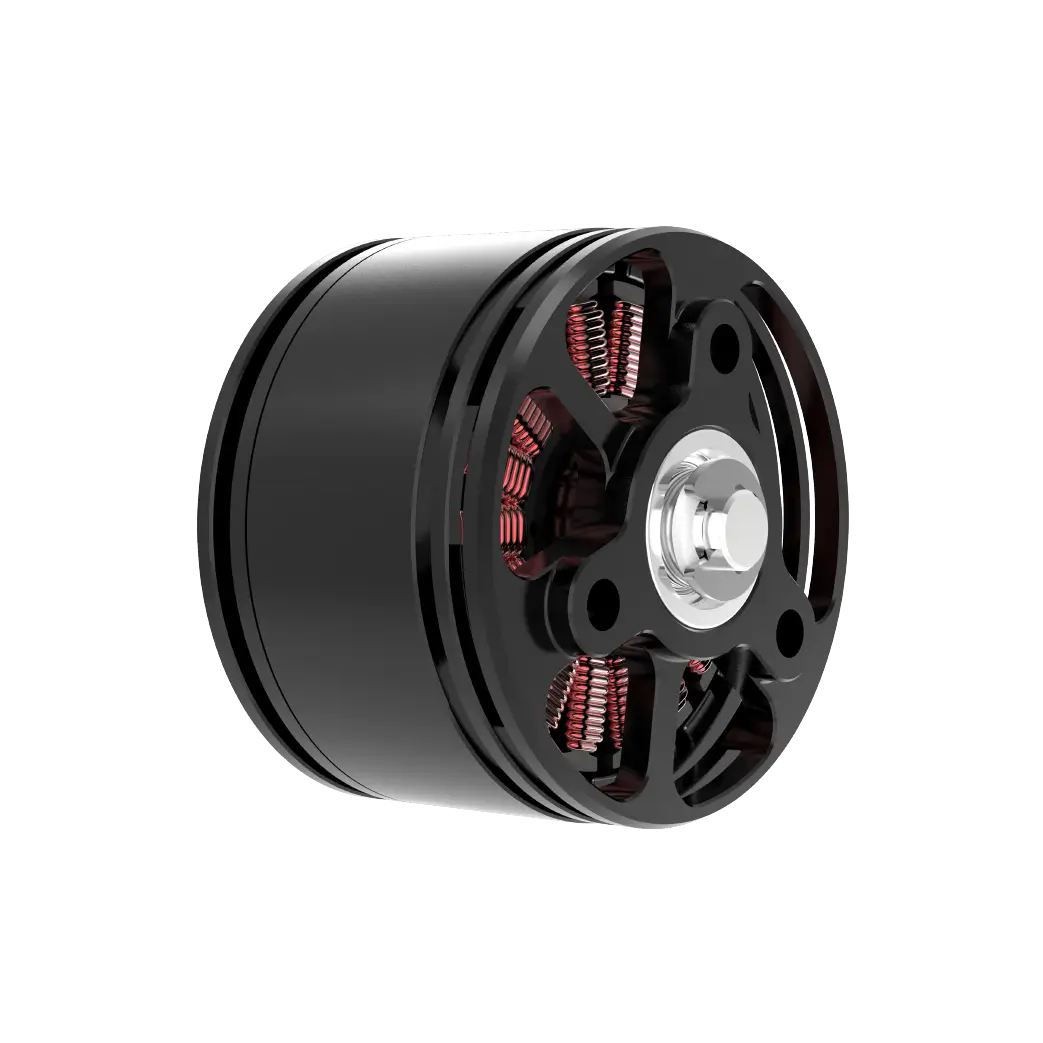
The motor and propeller form the core of the drone's propulsion system. When these two components are not aligned, the entire system suffers.
A motor's KV rating indicates the number of revolutions per minute (RPM) per volt applied. A high KV motor spins faster but produces less torque, making it suitable for small propellers on racing drones. A low KV motor spins slower but delivers more torque, which works well with larger propellers for lifting heavier payloads.
The propeller's diameter and pitch determine how much air it moves and how much current the motor must draw. A larger diameter or higher pitch increases thrust but also increases the load on the motor.
When the propeller load exceeds the motor's design limits, the motor generates more heat than it can dissipate. Over time, this degrades the magnets, damages the windings, and reduces efficiency. In extreme cases, the motor can fail mid-flight.
For buyers evaluatingdrone motors with propellers, the first step is to confirm that the motor's recommended propeller range matches the intended application. Most reputable manufacturers publish test data showing thrust, current, and efficiency for specific propeller sizes. This data should be reviewed before making a purchase decision.

2. Key Specifications to Check
When comparing motor and propeller combinations, focus on the following parameters:
A practical approach is to calculate the total weight of the drone, including the payload, battery, frame, and electronics. Then multiply that weight by two to determine the minimum total thrust required. Divide that by the number of motors to find the thrust per motor. Compare this value against the manufacturer's test data for the motor and propeller combination you are considering.
If the test data shows that the motor draws 20 amps at full throttle with a given propeller, but your battery and electronic speed controller (ESC) are rated for only 15 amps continuous, that combination is not suitable. Always verify that the ESC rating exceeds the motor's peak current draw.
3. How to Compare Motor and Propeller Combinations
Comparing different combinations requires a systematic method. Start by listing the application requirements:
Total drone weight (including payload)
Desired flight time
Operating environment (indoor, outdoor, high altitude)
Power source (battery voltage and capacity)
Next, identify motors that fall within the recommended KV range for your application. For a typical multirotor drone carrying a camera payload, motors in the 800 to 1200 KV range are common with 10 to 14 inch propellers. For smaller racing drones, motors may range from 2300 to 2600 KV with 5 inch propellers.
Once you have a shortlist, review the manufacturer's published test data. Look for the combination that provides the required thrust at the lowest current draw. This combination will typically deliver the longest flight time and generate the least heat.
Pay attention to efficiency curves. A motor may produce its peak thrust at 90% throttle, but operate most efficiently at 60% to 70% throttle. Selecting a combination that allows the motor to cruise at its efficient range, rather than near its maximum, will improve overall system reliability.
For buyers comparing similar options, a useful rule is to prioritize combinations where the motor's continuous current rating is at least 20% higher than the expected average current during flight. This margin provides a safety buffer for wind gusts, aggressive maneuvers, or unexpected payload shifts.
4. Common Mistakes When Selecting Drone Motors with Propellers
Even experienced engineers can fall into these traps. Being aware of them helps you avoid costly rework.
Mistake 1: Choosing a motor based only on KV rating.
KV rating alone does not tell you how much thrust the motor can produce. Two motors with the same KV can have different stator sizes, magnet strengths, and winding qualities, leading to very different performance. Always check thrust and current data.
Mistake 2: Using a propeller that is too large for the motor.
A larger propeller increases load and current. If the motor cannot dissipate the heat, the magnets may demagnetize, permanently reducing performance. This is a common cause of motors that suddenly lose power after a few flights.
Mistake 3: Ignoring the ESC rating.
The ESC must handle the peak current drawn by the motor. If the ESC is undersized, it can overheat and shut down, causing the drone to lose power mid-flight. Always confirm that the ESC rating exceeds the motor's maximum current.
Mistake 4: Assuming all propellers of the same size perform identically.
Propeller material, blade shape, and pitch accuracy vary between manufacturers. A cheap propeller may flex under load, reducing efficiency and causing vibration. For consistent performance, use propellers from reputable brands that publish performance data.
Mistake 5: Not accounting for altitude.
At higher altitudes, air density decreases, reducing propeller efficiency. A combination that works well at sea level may produce significantly less thrust at 3,000 meters. If your drone operates at high altitude, factor this into your thrust calculations.
5. Questions to Ask Before Ordering
Before finalizing a purchase, ask the supplier these questions:
What propeller sizes have you tested with this motor, and can you share the thrust and current data?
What is the maximum continuous current this motor can handle at the voltage I plan to use?
Do you provide efficiency curves for the recommended propeller combinations?
What is the recommended ESC rating for this motor and propeller combination?
Have you tested this combination with the battery capacity I am using?
What is the warranty policy if the motor fails due to overheating within the recommended operating range?
Do you offer matched sets of motors and propellers that are pre-tested for balance and performance?
Suppliers who can answer these questions with specific data are more likely to provide reliable products. Those who cannot be offering generic components without proper validation.
6. Practical Questions Buyers Often Ask
Q: Can I use any propeller with any motor as long as the mounting holes align?
No. The propeller must stay within the motor's recommended size range. Using an oversized propeller can cause overheating, reduced efficiency, and potential motor failure.
Q: What happens if I use a propeller that is too small?
The drone may not generate enough thrust to lift off or may require higher throttle settings, reducing flight time and increasing current draw.
Q: How do I know if a motor is overheating?
Many motors become hot to the touch after a flight. If the motor temperature exceeds 80°C (176°F) consistently, the combination may be drawing too much current. Some motors include temperature sensors that can be monitored through the flight controller.
Q: Is a higher KV motor always better for speed?
Higher KV motors spin faster but produce less torque. For speed applications, they work well with small propellers. For heavy lifting, lower KV motors with larger propellers are more effective.
Q: Do carbon fiber propellers perform better than plastic ones?
Carbon fiber propellers are generally stiffer and more efficient, but they are also more expensive and can be more brittle. Plastic propellers are more affordable and flexible, which can help absorb impacts. The choice depends on your application and budget.
Q: How often should I replace motors and propellers?
Replace propellers immediately if they show cracks, chips, or significant wear. Motors should be inspected after every 50 to 100 flight hours for bearing wear, magnet condition, and winding integrity.
Q: Can I mix different motor brands on the same drone?
It is not recommended. Different motors may have slightly different KV ratings, torque characteristics, or efficiency curves, which can cause uneven thrust and unstable flight.
Q: What is the most common cause of motor failure in drones?
Overheating due to mismatched propeller size or prolonged operation at maximum throttle is the most common cause. Proper matching and adequate cooling can significantly extend motor life.
7. Making a Better Long-Term Decision
Selecting the rightdrone motors with propellers is not just about getting the highest thrust number. It is about finding a combination that operates within safe limits, delivers the required performance, and maintains reliability over time.
Start by defining your application requirements clearly. Calculate your total weight and desired flight time. Identify the motor KV range and propeller size that fit your needs. Review manufacturer test data to confirm thrust, current, and efficiency. Verify that your ESC and battery can support the combination. Ask suppliers for specific data before ordering.
If you are evaluating multiple options, consider requesting a matched set of motors and propellers that have been pre-tested for balance and performance. This reduces the risk of receiving components that do not work well together.
For buyers who want to avoid common pitfalls, working with a supplier that provides detailed technical documentation and responsive engineering support can make a significant difference. When you have the right data and the right partner, the selection process becomes straightforward, and the final system performs as expected.
If you are currently reviewing options or need assistance matching motors and propellers for your specific application, contact our engineering team. We can review your requirements, suggest suitable combinations, and provide the test data you need to make a confident decision.
Update Time:2026-07-22

Contact Kpower's product specialist to recommend suitable motor or gearbox for your product.


